
The short answer: the bar-headed goose is the bird with the strongest, most credible documented evidence of flying at altitudes that would put it at or above Mount Everest's peak. But the full story is worth knowing, because the question trips people up in a few specific ways, and getting the nuance right makes the answer a lot more satisfying.
Which Bird Can Fly Over Mount Everest? The Definitive Answer

Marcus Chen
22 Mar 2026
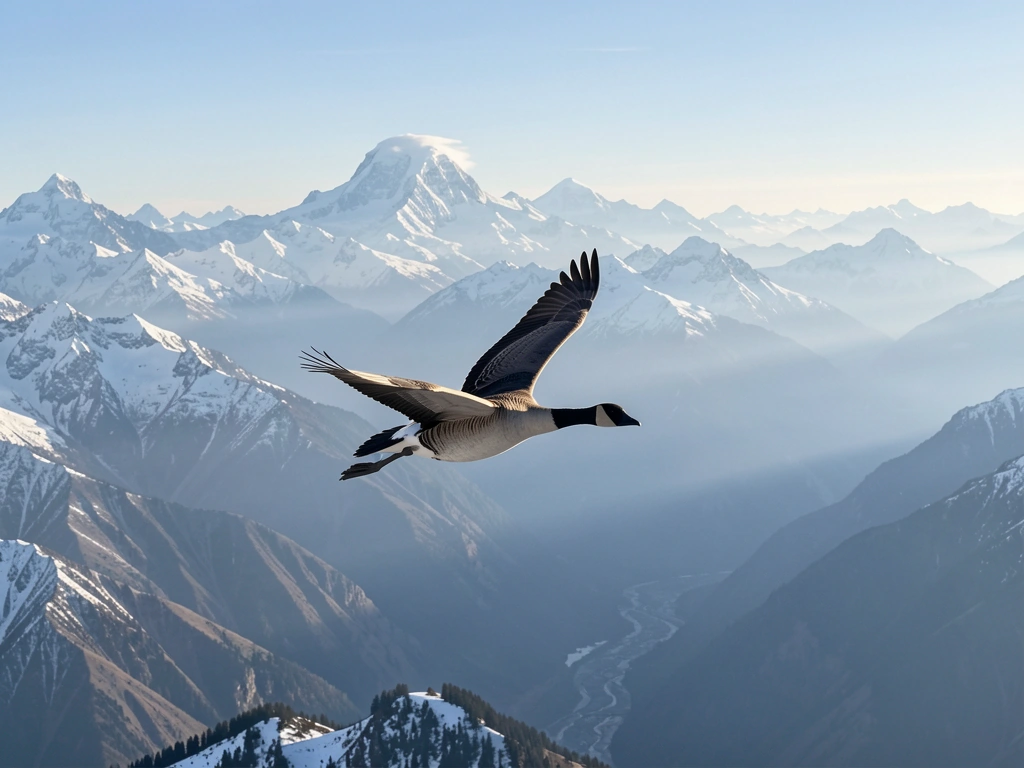
What Everest's altitude actually means for this question
Mount Everest's official height, as jointly declared by Nepal and China in 2020, is 8,848.86 meters (29,031.69 feet) above sea level. That number is the globally accepted standard today. You'll sometimes see 8,849 m rounded up, and older sources still cite the previous survey figures from 1999 or 2005, which is part of why you get slightly different numbers depending on where you look. For the purposes of this question, treat 8,849 m as the target altitude a bird would need to reach to legitimately fly 'over' Everest's summit.
Here's the thing about 'flying over,' though: it doesn't technically mean a bird has to fly directly above the peak. It means the bird needs to sustain flight at that altitude, whether it's crossing the Himalayas on a migratory path or soaring in thermals near the ridge. If a bird hits 8,849 m anywhere in the Himalayas, that counts as flying at Everest-level altitude. This distinction matters when you look at the data.
Why most birds can't get anywhere near that altitude
At 8,849 m, the air is brutally thin. Atmospheric pressure is roughly one-third of what it is at sea level, which means there's far less oxygen available per breath and far fewer air molecules for wings to push against. Most birds are already operating near their physiological ceiling at 3,000 to 4,000 m. The problems stack up fast above that level.
- Reduced oxygen: muscles need oxygen to power the continuous contractions of flapping flight; at extreme altitude, most birds simply can't generate enough energy to keep going.
- Thin air means less lift: wings generate lift by creating pressure differences between their upper and lower surfaces, and thinner air makes that harder, requiring either faster wingbeats (more energy) or larger wing surface area.
- Temperature: temperatures near Everest's summit can drop to minus 40 degrees Celsius or colder, and most birds lack the metabolic capacity to sustain flight while managing that kind of cold.
- Wind and turbulence: the jet stream crosses the Himalayas at high altitude, creating unpredictable, violent airflow that would overwhelm most birds' flight control.
The birds that do manage extreme altitude have evolved very specific adaptations to get around these limits. Their hemoglobin binds oxygen more efficiently at low partial pressures, their hearts are proportionally larger, and their lung ventilation rates adjust dramatically. These are not minor tweaks. They represent millions of years of selection pressure in high-altitude environments.
The birds with documented evidence of Everest-level flight
Bar-headed goose: the strongest case
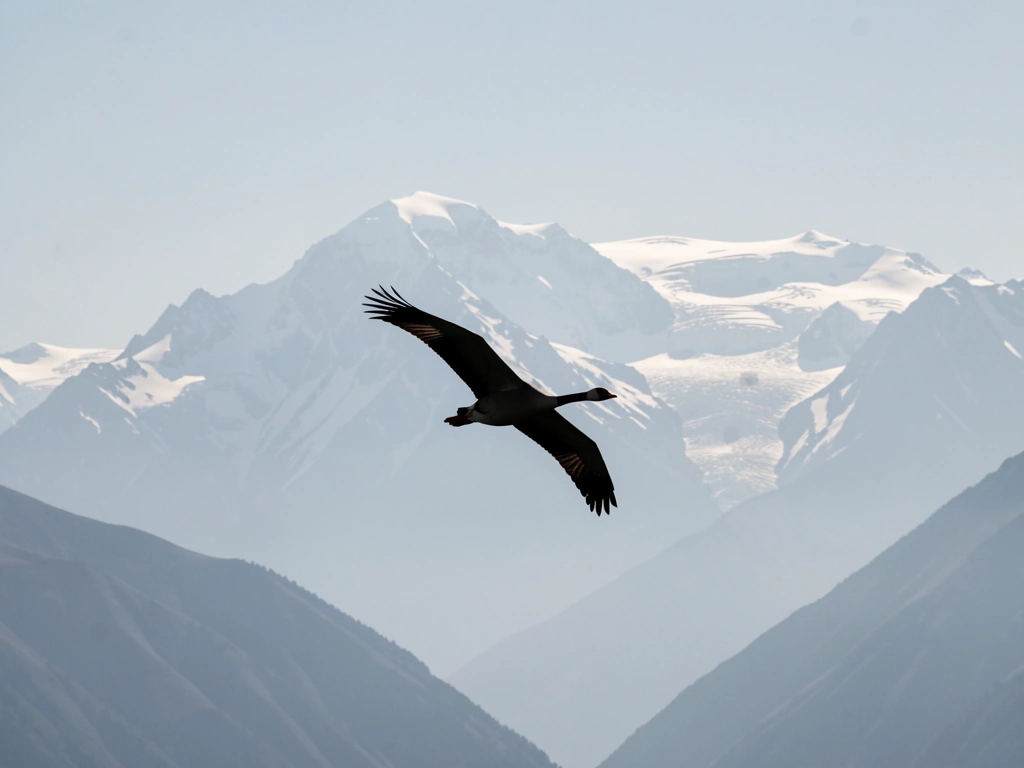
The bar-headed goose (Anser indicus) is the gold standard here. These birds breed in Central Asia and winter in South Asia, migrating twice a year across the Himalayas. Telemetry studies, including GPS and pressure-sensor data published in peer-reviewed journals, have recorded flying at altitudes exceeding 7,000 m routinely, with some individuals recorded above 8,000 m. One study recorded a bird at approximately 8,481 m, and observer accounts from climbers near Everest have placed geese at or near summit level. The physiological adaptations in bar-headed geese are among the most studied in all of avian biology: their hemoglobin has a structural modification that gives it unusually high oxygen affinity at low partial pressures.
Critically, these aren't one-off freak events. Bar-headed geese cross the Himalayas on a seasonal schedule, meaning this is habitual behavior, not a record-breaking outlier. That's what separates them from most other high-altitude claims.
Rüppell's griffon vulture: the absolute altitude record
For sheer altitude records, the Rüppell's griffon vulture (Gyps rueppelli) holds the documented record for any bird: a collision with a commercial aircraft over Ivory Coast in 1973 at approximately 11,300 m (37,000 ft). That's well above Everest's summit. However, this bird is African, not Himalayan, and there is no evidence it crosses Everest or the Himalayas at all. So while it can clearly fly higher than Everest, it doesn't 'fly over Everest' in any meaningful geographic sense.
Himalayan and other high-altitude species worth knowing
A few other species have credible high-altitude observations, though with less rigorous documentation than the bar-headed goose.
- Bearded vulture (Lammergeier, Gypaetus barbatus): regularly soars above 5,000 m in the Himalayas and has been observed above 7,000 m, though GPS telemetry data at Everest-level altitudes is sparse.
- Common crane (Grus grus): tracked via radar during Himalayan crossings at altitudes above 5,000 m, with some records approaching 6,000 m, but not reliably at Everest summit level.
- Alpine chough (Pyrrhocorax graculus): frequently observed by climbers at very high altitudes on Everest itself, including above 8,000 m, scrounging food near camps. These are not sustained migratory flights but short foraging excursions at extreme altitude.
The alpine chough sighting above 8,000 m on Everest's slopes is often cited as evidence of birds 'flying over' Everest, but it's worth being precise: foraging hops at high camp are not the same as sustained altitude flight at 8,849 m. The bar-headed goose, with its documented migratory crossings and telemetry data, remains the most defensible answer.
How to check the claims yourself
If you want to verify any of this, the hierarchy of sources to trust looks roughly like this: peer-reviewed telemetry studies published in journals like 'Science,' 'PLOS ONE,' or 'Journal of Experimental Biology' are the most reliable. eBird (Cornell Lab of Ornithology's global observation database) aggregates credible birder sightings with GPS coordinates and timestamps. BirdLife International maintains species range maps and altitude data. For Everest's official elevation, the 2020 Nepal-China joint survey result of 8,848.86 m is the current gold standard.
What to be skeptical of: viral social media posts, travel blogs, and general-interest wildlife articles that don't cite primary sources. High-altitude bird claims get repeated and exaggerated constantly, and the bar-headed goose's story in particular gets inflated into 'regularly flies over the summit of Everest,' which overstates what the telemetry data actually shows. Some tracked birds go around the highest ridges rather than directly over them, hugging lower passes where possible. That's not cheating: it's smart navigation. But it does mean the phrase 'flies over Everest' needs to be interpreted carefully.
Seasonality is also important. Bar-headed geese cross the Himalayas primarily in spring (northbound, March to May) and autumn (southbound, September to November). If you're looking for sightings or planning to observe them, those windows are your best bet. High-altitude climbers on Everest during the spring climbing season (April and May) are the most likely people to encounter these birds near the summit zone.
Side-by-side: the strongest high-altitude bird candidates
| Bird | Max Documented Altitude | Himalayan Range? | Habitual or One-Off? | Evidence Quality |
|---|---|---|---|---|
| Bar-headed goose | ~8,481 m (GPS telemetry) | Yes | Habitual migration | High: peer-reviewed telemetry |
| Rüppell's griffon vulture | ~11,300 m (aircraft strike) | No | One-off record | Medium: confirmed via aircraft wreckage |
| Alpine chough | >8,000 m (climber obs.) | Yes | Opportunistic foraging | Medium: eyewitness, no telemetry |
| Bearded vulture | ~7,000 m (obs. + partial telemetry) | Yes | Regular soaring | Medium: limited telemetry data |
| Common crane | ~5,000–6,000 m (radar) | Yes (migratory) | Habitual migration | Medium: radar tracking |
Myths that keep circulating and why they stick
The most common myth is that cranes or swans 'fly over Everest at 30,000 feet.' This number comes from misquoting the Rüppell's vulture aircraft-strike record and misattributing it to Himalayan species. Swans are occasionally cited in this context, but there's no credible telemetry or observational data placing whooper swans or any swan species above Everest-level altitudes during Himalayan crossings.
Another persistent myth is that bar-headed geese fly in a straight line directly over the Everest summit. What the research actually shows is more interesting: the geese tend to track topographic features and use mountain passes where possible, which means their routes are dynamic and wind-dependent. Some individuals do ascend to near-summit altitudes when they need to cross high ridges, but they're not flying a predictable straight line over the top of Everest specifically.
The reason these myths persist is simple: the true story is already impressive enough that it gets rounded up. A goose flying at 8,400 m across the Himalayas is genuinely extraordinary. Saying it 'flies over Everest' is close enough to true that most people don't push back on it. But if you want the most accurate answer, the distinction between 'near Everest-level altitude' and 'directly over the Everest summit at 8,849 m' is real and worth keeping.
The direct answer, and what to do with it
If someone asks you which bird can fly over Mount Everest, the most defensible answer is the bar-headed goose. It has peer-reviewed telemetry data showing flight at altitudes approaching Everest's summit height, it does this on a seasonal schedule, it lives in the Himalayan region, and its physiology has been studied thoroughly enough to explain exactly how it pulls it off. The Rüppell's griffon vulture holds the absolute altitude record for any bird, but it's not a Himalayan species and doesn't cross Everest.
If you want to dig deeper, look up the work of researcher Lucy Hawkes and colleagues, whose GPS and heart-rate telemetry studies on bar-headed geese are the most rigorous data available. The Cornell Lab's eBird platform is a good place to explore real-time and historical sighting data if you're interested in where these birds are observed. And if you're curious about what other birds achieve at extreme altitudes, topics like some of the same physiology in a broader context.
The takeaway is this: the bar-headed goose doesn't just survive at Everest-level altitude. It flies through it efficiently, repeatedly, and on a schedule you can predict. That's the real story, and it's more impressive than any myth.
FAQ
Does “flying over Mount Everest” mean the bird must cross directly above the summit point at 8,848.86 m?
Not necessarily. In bird-observation terms, “over Everest” is usually shorthand for reaching or sustaining Everest-level altitude anywhere in the Everest region. The bar-headed goose is strongest on this interpretation because telemetry shows flights around the altitude range, but their routes can follow passes and terrain rather than a straight, guaranteed line over the summit itself.
What altitude should I use if I want to check the claim today, and how do rounding differences affect it?
Use 8,848.86 m (29,031.69 ft) as the current official target, then recognize that some articles round to 8,849 m. A bird “counting” for the claim depends on whether its recorded altitude crosses that threshold under the specific instrument calibration and reporting method used in the study.
How reliable are GPS and pressure-sensor altitude readings for high-altitude bird tracking?
They can be quite good, but they are not identical. Pressure-derived altitude depends on temperature and weather conditions, so robust studies use calibrated sensors and error checks. If a claim relies on a single low-confidence measurement or lacks details about sensor type and validation, treat it as weaker than telemetry from peer-reviewed tracking work.
Do bar-headed geese fly over Everest year-round or only during certain seasons?
Primarily during spring (northbound, roughly March to May) and autumn (southbound, roughly September to November). If you’re trying to see them near the Everest region, timing matters more than luck, and the highest chance is typically aligned with those migration windows.
Can I use climbers’ reports of geese near Everest summit level as proof they flew at Everest altitude?
They are useful as leads, but they usually lack the precision of instrumented tracking, such as exact altitude at the moment of observation. Treat climber accounts as supportive context, not definitive measurement, unless they include clear altitude estimates, dates, and corroboration with known flight patterns.
Why do some people claim cranes, swans, or other birds fly over Everest at “30,000 feet”?
That number typically comes from misquoting an entirely different altitude record, then attributing it to Himalayan species. Even if some species can reach extreme heights elsewhere, “over Everest” requires geographic relevance and sustained altitude evidence during Himalayan crossings, which the swan and crane claims usually do not provide.
Is the Rüppell’s griffon vulture technically “the bird that flies higher than Everest,” and does that answer the question?
It does fly higher than Everest based on a well-known aircraft-collision altitude record. However, the question is about flying over Mount Everest, and there is no evidence this African species reliably crosses the Himalayas or Everest region. So it can be right for “highest flight,” wrong for “over Everest.”
Do bar-headed geese always fly directly over high ridges, or can they avoid the highest points?
They can avoid the highest terrain when possible. Their observed movements are wind- and topography-dependent, so they may use mountain passes and lower corridors. That affects how confidently you can interpret “over the summit,” even when they still hit Everest-level altitude somewhere nearby.
How should I evaluate viral claims about “birds over Everest” when they provide no sources?
If there are no primary data, no identifiable study or tracking method, and no ability to cross-check dates and locations, treat the claim as unverified. High-altitude bird stories spread quickly and often get upgraded in certainty without new evidence.
If I want to verify sightings for bar-headed geese in the Everest region, what details should I look for?
Look for records with timestamps and locations tied to Himalayan migration periods, and prefer reports that include coordinates or altitude estimates from reliable observers. Aggregated databases can help, but you still want to check whether the observation plausibly falls within the migration windows and whether altitude information is present or modeled.
Next Article
The Bird Is Flying Above the House: What to Do Today
Step-by-step actions to deter a bird flying above your house, identify causes, and handle nests safely without harm.